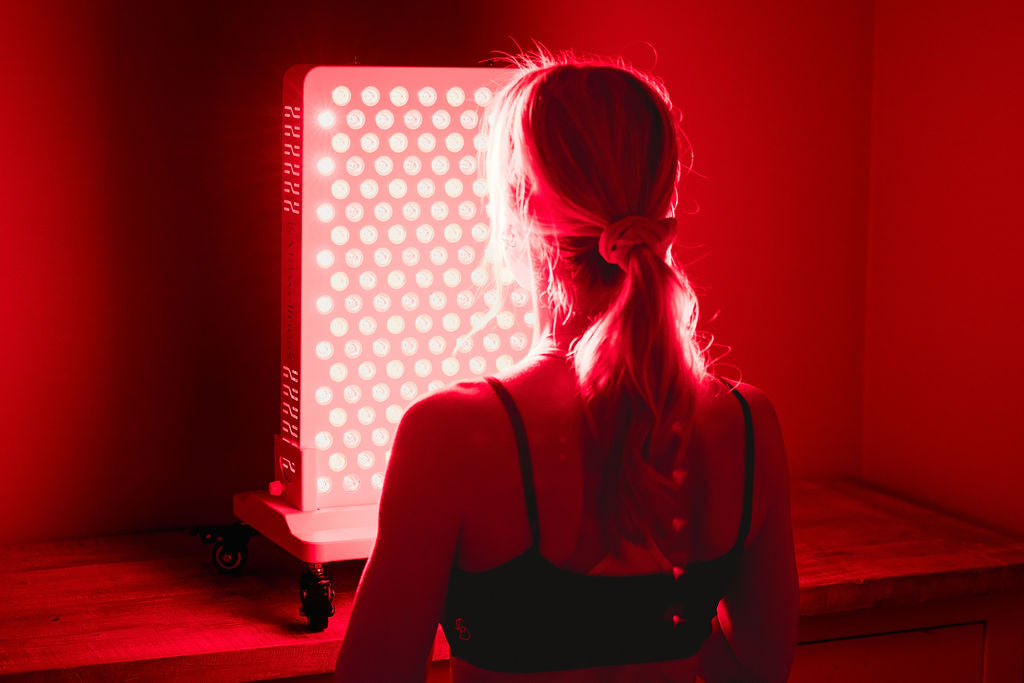
Red Light Therapy: What the Science Actually Says
Red light therapy has gone from clinical obscurity to wellness mainstream in a few years. With that speed comes noise — bold claims, sceptical headlines, and a lot of confusion about what actually has evidence behind it and what doesn't.
This is our attempt at an honest read of the science. No hype in either direction. Just what the research currently supports, what it's still working through, and what you should know before forming a view.
What Red Light Therapy Actually Is
Red light therapy — technically called photobiomodulation (PBM) or low-level laser therapy (LLLT) — involves exposing the body to specific wavelengths of red and near-infrared light at therapeutic doses.
The key word is specific. Not all red light is the same. The wavelengths that have been studied most extensively — and that appear to have the strongest biological effects — sit in two ranges:
- Red light (630–670nm): Absorbed primarily by the outer layers of tissue. Most studied for skin health, wound healing, and surface-level inflammation.
- Near-infrared (NIR) light (810–850nm): Penetrates deeper into tissue — through skin, into muscle, joint, and even bone. Most studied for muscle recovery, joint inflammation, and cellular energy production.
Some panels — including LUM8's — also include 1060nm wavelength, which represents even deeper near-infrared penetration. The research base for 1060nm is smaller but growing, with early evidence pointing to mitochondrial support at depth.
The Mechanism: How Light Becomes Biology
For decades, the main critique of red light therapy was that it lacked a plausible mechanism — a clear explanation for how light could affect cells. That critique no longer holds.
The primary mechanism is now well-established: red and NIR wavelengths are absorbed by an enzyme inside the mitochondria called cytochrome c oxidase (CCO). CCO is a critical component of the electron transport chain — the process by which cells produce ATP (adenosine triphosphate), the body's fundamental energy currency.
When CCO absorbs red/NIR light, it produces more ATP. More ATP means more cellular energy available for repair, regeneration, and function. This effect has been demonstrated in cell cultures, animal models, and human clinical trials across dozens of research groups worldwide.
A 2017 review in Photobiomodulation, Photomedicine, and Laser Surgery (Hamblin) described photobiomodulation as "one of the most exciting new treatment modalities to emerge in recent years," with a growing body of peer-reviewed evidence across multiple clinical domains.
What the Evidence Supports
The following areas have the strongest and most consistent research base:
Skin health and wound healing
This is the most thoroughly studied application. Multiple randomised controlled trials have demonstrated that red light (630–670nm) supports collagen synthesis, accelerates wound healing, and reduces the appearance of fine lines and sun damage. The mechanism — increased fibroblast activity and collagen production driven by enhanced ATP — is well understood.
Muscle recovery and performance
A 2016 meta-analysis in the European Journal of Sport Science reviewed 13 randomised controlled trials and found that pre-exercise PBM treatment consistently reduced muscle fatigue, delayed onset muscle soreness (DOMS), and supported faster recovery between training sessions. NIR wavelengths (810–850nm) are most effective here due to deeper tissue penetration.
Joint health and inflammation
A 2009 Cochrane review on low-level laser therapy for rheumatoid arthritis found meaningful reductions in pain and morning stiffness compared to placebo. Research in osteoarthritis populations has shown similar results. The anti-inflammatory effect appears to be driven by modulation of reactive oxygen species (ROS) and pro-inflammatory cytokines at the cellular level.
Sleep and circadian support
This is a newer but growing area. A 2012 study in the Journal of Athletic Training found that 14 days of full-body NIR light therapy significantly improved sleep quality and melatonin levels in female athletes. The proposed mechanism involves support of the pineal gland's melatonin production via NIR penetration to deeper brain structures.

What the Evidence Is Still Working Through
Honesty matters here. There are areas where the research is promising but not yet conclusive:
- Traumatic brain injury and neurodegeneration: Early animal studies and small human trials show interesting signals, but large-scale RCTs are still underway.
- Thyroid function: Some studies have shown benefits in Hashimoto's thyroiditis specifically, but the evidence base is limited and the mechanism not fully understood.
- Hair growth: Multiple trials have shown effects on androgenic alopecia, but study quality varies significantly.
The wellness industry sometimes gets ahead of the science in these areas. Our position: if the research is emerging, say it's emerging. Don't present promising early data as established fact.
What to Look for in a Red Light Device
Not all panels are equal. The variables that determine whether a device delivers therapeutic doses are:
- Wavelength accuracy: The device should specify which wavelengths are included and have third-party testing to confirm them.
- Irradiance: Power density at a given distance (measured in mW/cm²). Most research protocols use 10–100 mW/cm². Higher isn't always better — but too low won't deliver a therapeutic dose.
- Treatment distance and duration: Follow the research protocols. Closer isn't always more effective, and longer sessions don't always mean better outcomes.
- Certifications: In Australia, electrical devices should be RCM certified. This is a basic safety assurance, not optional.
LUM8 red light panels are RCM certified and include 8 wavelengths — from 630nm red through to 1060nm deep near-infrared — with third-party irradiance testing. We publish the specs because the science matters, and so does the device delivering it.