Article: Why You Can't Fall Asleep (It Has Nothing To Do With Your Phone)
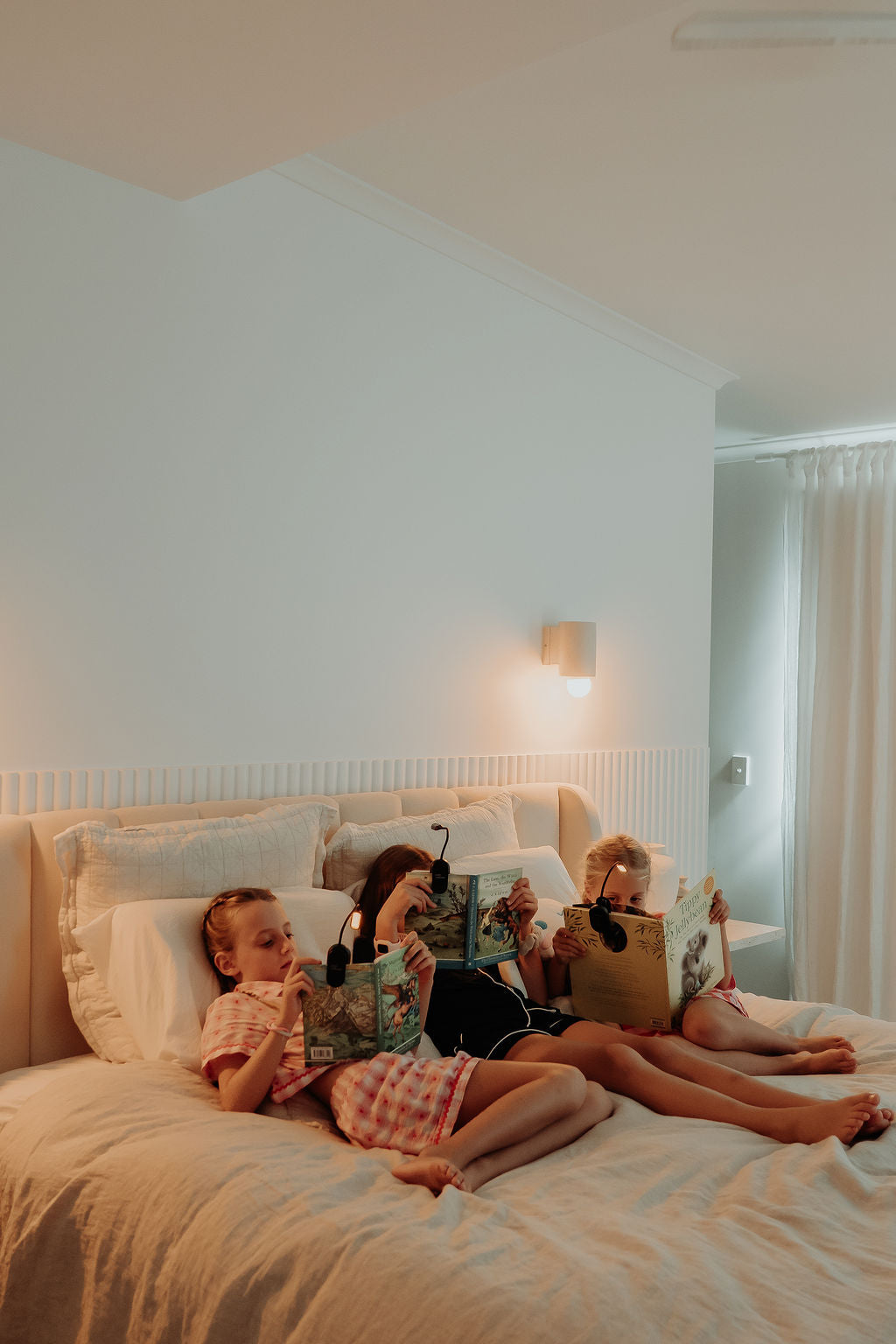
Why You Can't Fall Asleep (It Has Nothing To Do With Your Phone)
Most people have heard the advice: put your phone down an hour before bed.
They try it. It helps a little. But the underlying problem — lying awake, mind racing, finally drifting off at midnight when the alarm is set for 6 — doesn't really go away.
That's because the phone is a symptom, not the cause.
The real issue is light itself. And your home is full of it.
What Actually Controls Sleep
Deep in the centre of your brain sits a cluster of around 20,000 neurons called the suprachiasmatic nucleus — or SCN. It's your body's master clock. Every cell in your body has its own biological timer, and the SCN coordinates them all — telling your heart when to slow, your liver when to pause, your skin when to repair, your brain when to consolidate memory.
The SCN takes its cues from one thing above everything else: light.
When light hits the retina, a signal travels directly to the SCN. Bright, blue-rich light says it's daytime. The SCN suppresses melatonin, raises cortisol, and keeps the body alert and awake.
Dim, warm light — or darkness — says evening is coming. The SCN triggers the pineal gland to release melatonin. Body temperature drops. Heart rate slows. Sleep pressure builds.
This system evolved over hundreds of thousands of years in an environment where the only light after sunset was fire. Warm. Orange-red. No blue. No flicker. No LEDs.

The Problem Isn't Your Phone. It's Your Whole Home.
Yes, your phone emits blue light. But so does every other light source in your home after dark.
Your LED downlights. Your kitchen strip lights. Your bathroom mirror lights. The standby LED on your TV. The charging indicator on your toothbrush. The router blinking in the corner.
A study published in the Journal of Clinical Endocrinology & Metabolism found that blue light wavelengths — specifically in the 446–484 nanometre range — suppress melatonin at twice the rate of green light, and can shift the circadian clock by up to three hours.
Three hours. That means your body, under standard home LED lighting at 9pm, biologically believes it's 6pm. It's not ready for sleep. It won't be for hours. You're not broken — your environment is lying to your biology.
What Your Ancestors Had That You Don't
Before electricity, human evenings looked like this: the sun set, light shifted from blue-white to amber-red, and the body's clock received a clear signal. Melatonin rose. Cortisol fell. Within a few hours, sleep came naturally.
That transition — the circadian light cascade — is still hardwired into every human body. Your biology hasn't changed. Your environment has.
The solution isn't to give up on modern life. It's to give your body the signals it was designed to receive.
Five Things You Can Do Tonight — For Free
None of these cost anything. All of them are grounded in the same circadian science used by the world's top sleep researchers.
1. Kill the overhead lights after 8pm
Overhead lighting is the single biggest disruptor of evening melatonin. It's bright, blue-rich, and hits the retina from above — exactly where the photoreceptors that regulate the circadian clock are most sensitive. Switch to floor lamps or table lamps in the evening. The difference in how quickly you feel tired is often noticeable within the first night.
2. Switch your bulbs to the warmest setting you can find
Most homes run LEDs at 4,000–6,500K — a blue-white, daytime-spectrum light that tells your brain it's midday. Swap your evening bulbs to 2,200–2,700K (the warm amber range). This alone can make a significant difference to how easily you fall asleep. Your phone's night mode does this for the screen — but only the screen. The rest of your home stays on daylight.
3. Cover standby and indicator lights in the bedroom
A single LED indicator in a dark room is enough light for the SCN to register. Blue and green standby lights are especially disruptive. A small piece of black electrical tape over charging lights, router LEDs, and TV standbys costs nothing and has a measurable effect on sleep depth and next-day alertness.
4. Get 10 minutes of outdoor light within an hour of waking
Your circadian rhythm needs a morning anchor just as much as an evening one. Morning sunlight — ideally before 9am — triggers the cortisol awakening response and sets the timing clock that determines when melatonin rises that night. This one daily habit, more than almost any other, stabilises sleep timing over weeks and months.
5. Dim everything 90 minutes before you want to sleep
Not just your phone — every light in your home. The body takes approximately 60–90 minutes to build meaningful melatonin levels once light stimulus is reduced. Give it that time. Use dimmers, turn off unnecessary lights, and shift your environment into wind-down mode deliberately and consistently.

What the Research Says
This isn't fringe science. It's established, replicated, and increasingly mainstream:
- Gooley et al. (2011), Journal of Clinical Endocrinology & Metabolism: Exposure to room light before bedtime suppressed melatonin onset in 99% of individuals and shortened melatonin duration by 90 minutes.
- Lockley et al. (2003), Journal of Clinical Endocrinology & Metabolism: Even dim light exposure at night significantly disrupted circadian rhythm regulation.
- Chang et al. (2014), PNAS: Reading on a light-emitting device before bed delayed the circadian clock by 1.5 hours, reduced melatonin by 55%, and reduced next-morning alertness — even after 8 hours of sleep.
A Different Way to Think About Your Home
Most wellness advice focuses on what you do: take this supplement, follow this routine, download this app. But your home environment runs 24 hours a day whether you're paying attention to it or not. The light in your space is either working with your biology or against it — continuously, passively, every evening, every night.
The good news is that the body is remarkably responsive. Change the light environment, and the circadian clock begins adjusting within days. Sleep improves. Energy the next morning improves. Mood improves. Not because of any single intervention, but because the body's systems — finally getting the signals they were designed to receive — start working the way they were built to.
Start with the overheads. Switch them off at 8pm tonight. See what happens.
At LUM8 Wellness, everything we make is designed around one idea — that your home should support your body's natural rhythm, not fight it. From circadian-spectrum lighting to red light therapy panels and PEMF mats, our tools work with the science above. But the first step is always free.